
Workflow Automation with AI Tools: From Tasks to Intelligent Systems
By Edson Santos • Updated: December 2025
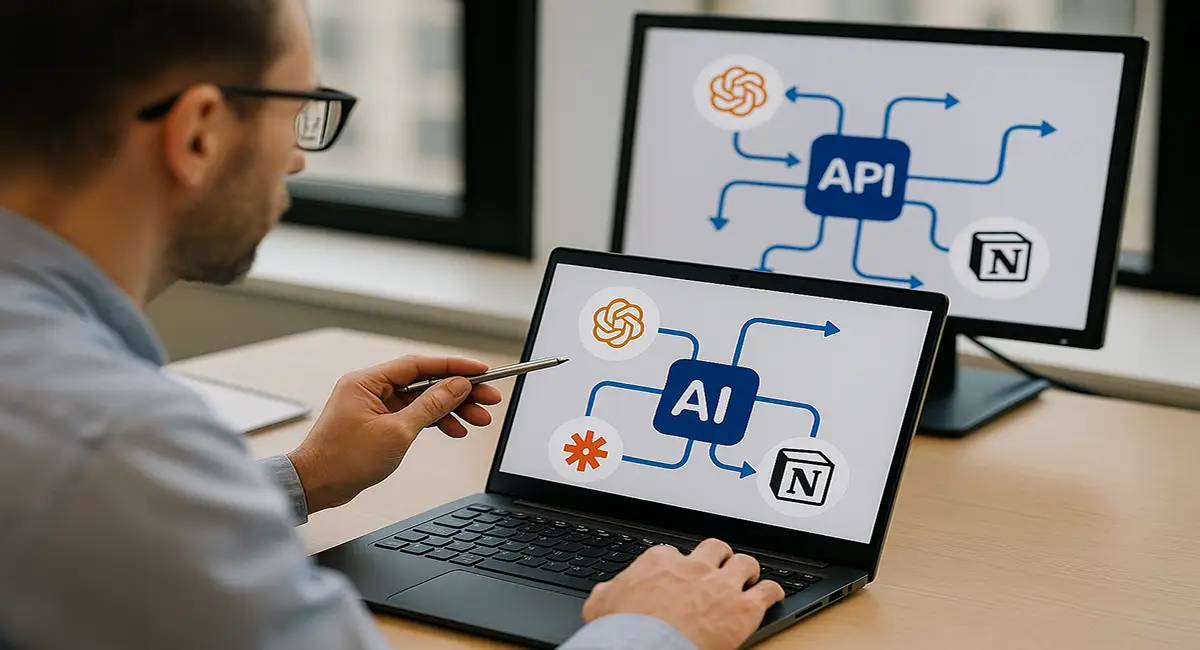
Workflow automation with AI is not just about speed. It is about reducing cognitive overload, creating consistency, and transforming fragmented tasks into systems that learn, adapt, and support human decision-making over time. In the modern digital organization, the competitive advantage lies not in who works the hardest, but in who builds the most intelligent and resilient operational systems.
In recent years, automation has evolved beyond simple triggers and actions. With the proliferation of accessible AI tools such as ChatGPT, Zapier, and Notion AI, workflows are becoming more contextual, flexible, and intelligence-driven. The fundamental question has shifted. Instead of asking “how do I automate this repetitive task?”, forward-thinking organizations now ask “how do I design workflows that understand user intent, interpret timing, and deliver contextual relevance?” This represents a move from mechanical efficiency to strategic augmentation.
This profound shift marks the critical transition from basic task automation to workflow intelligence — a model where automated systems act as force multipliers for human strategy, enhancing creativity and oversight rather than aiming to replace them. The goal is symbiotic productivity, where machines handle scale and pattern recognition, and humans focus on nuance, ethics, and innovation.
1. The Strategic Imperative: Why AI-Driven Workflow Automation Matters
Manual, ad-hoc workflows are a significant source of operational friction. Repetitive tasks drain focused attention, introduce human error and inconsistency, and create bottlenecks that slow down strategic thinking and innovation. Basic automation removes these low-level constraints by standardizing execution, but AI-enhanced automation unlocks a new tier of value.
Unlike rules-based systems that execute fixed “if-then” commands, AI-driven workflows can interpret unstructured data, summarize complex information, classify content by intent, and adapt their outputs based on evolving inputs and historical patterns. This allows workflows to remain useful and accurate even as market conditions, data formats, and business goals change. A simple example is an email triage system: a basic rule might filter emails from a specific sender; an AI-enhanced system can analyze the content, sentiment, and urgency of *all* incoming emails and route them to the appropriate team or priority folder.
Core Principle: The ultimate goal is not to eliminate human involvement, but to architect human-in-the-loop (HITL) systems. In this model, AI handles the volume, data processing, and initial structuring, while humans provide essential oversight, ethical judgment, creative direction, and final decision-making. This combines the scale of automation with the wisdom of human experience.
2. Building the Foundation: The Modern AI Automation Stack
You don't need a team of machine learning engineers to start. A powerful and accessible AI automation stack for 2025 can be built with interoperable tools that serve distinct roles:
- ChatGPT & Advanced LLMs (The "Brain"): Acts as the cognitive interface. It supports ideation, summarization of long reports, sentiment classification of feedback, drafting of communications, and even generating code snippets for other automations. Its role is to add understanding and language-based reasoning to workflows.
- Zapier / Make.com (The "Nervous System"): Serves as the integration orchestrator. These platforms connect triggers and actions across hundreds of apps and APIs (like Gmail, Slack, Google Sheets, CRM platforms) without requiring custom code. They are the glue that moves data and instructions between the AI brain and other business tools.
- Notion AI / Coda (The "Central Nervous System & Memory"): Functions as the centralized operational hub. It structures workflows, documents processes, stores knowledge bases, and transforms raw data from various automations into organized, query-able assets. It’s where the output of intelligence becomes actionable institutional knowledge.
Together, these tools form a cohesive automation layer that connects strategic thinking, seamless execution, and persistent documentation into a continuous, learning operational system. The stack is greater than the sum of its parts.
3. The Evolution: From Linear Tasks to Adaptive, Intelligent Workflows
Traditional automation is linear and deterministic: if this trigger occurs, then perform that exact action. AI-driven workflows introduce probabilistic reasoning and adaptation. They can evaluate the quality of content, detect anomalies in data, suggest optimizations, and choose between different response pathways based on learned patterns rather than rigidly programmed instructions.
Consider a content moderation workflow. A linear system might flag posts containing a list of banned keywords. An intelligent AI workflow, however, can analyze the context, discern sarcasm from genuine hostility, assess the sentiment of the entire thread, and only escalate items that meet a complex threshold of risk. It reduces false positives and adapts to new forms of misuse.
Over time, these workflows become more reliable and valuable because they are designed to incorporate feedback loops. They can be tuned based on which outcomes humans accept or reject, creating systems that improve with use rather than degrade due to changing circumstances.
4. A Practical Blueprint: An End-to-End AI-Enhanced Content Workflow
Let's examine a concrete, scalable example of an AI-assisted workflow for content operations:
- Ideation & Trend Analysis: ChatGPT, prompted with industry themes and past performance data, generates a list of potential topics and angles. It can also summarize trending discussions from Reddit or news sites to inform ideas.
- Approval & Project Creation: A human editor reviews and selects topics. Zapier then automatically creates a corresponding project card in a Trello board and a new page in a Notion content database, populating it with the brief.
- Research & Outline Generation: Notion AI (or ChatGPT via API) is triggered to expand the brief into a structured outline, pulling key questions from "People Also Ask" data and suggesting relevant subheadings (H2/H3) based on top-ranking articles.
- Drafting & Enrichment: A writer develops the draft. AI tools assist by suggesting data points, creating simple graphics from descriptions, or ensuring consistent terminology.
- Editorial Review & Quality Gate: The draft undergoes human review for tone, accuracy, and strategic alignment. A separate AI step can check for readability score and basic SEO structure.
- Publication & Distribution: Upon approval, Zapier schedules the post in WordPress, auto-shares snippets to social media platforms via Buffer, and adds a task for the team to engage with comments.
- Performance Feedback Loop: Google Analytics data on the post's performance is fed weekly into a spreadsheet. ChatGPT analyzes this to produce a one-paragraph insight (e.g., "Titles with question formats had 20% higher CTR"), which is added to the Notion database to inform future ideation (closing the loop).
This process amplifies editorial responsibility with consistency, traceability, and massive scalability. It turns content creation from a craft into a scalable, data-informed system.
5. Navigating the Limits: Risks and Governance in AI Automation
Automation is not a set-and-forget solution. AI systems, particularly LLMs, can suffer from "hallucination," misinterpreting context, generating plausible but inaccurate summaries, or unconsciously reinforcing biases present in their training data. An over-reliance on automation can also reduce organizational flexibility and resilience; when a highly interconnected system fails or produces an error, it can propagate quickly.
Key risks include:
- Opacity: Not understanding why an AI made a certain decision (the "black box" problem).
- Data Dependency & Drift: Workflows degrading as the real-world data they process evolves away from their training data.
- Over-Automation: Removing necessary human judgment from sensitive processes, leading to ethical or customer service failures.
Mitigation Strategy: Therefore, effective AI workflows must be designed with intentional checkpoints, comprehensive logging, and clear human accountability gates. The principle is that automation should assist and inform human judgment, not replace it for critical decisions. Regular audits of AI outputs are essential.
6. The Non-Negotiable Foundation: Ethics, Transparency, and Trust
Ethical automation is transparent automation. Teams and end-users should always be aware when an AI system is involved in a process, what data it is using, and the logic behind its outputs as much as is practical. This is crucial for maintaining trust, both internally and with customers.
Adherence to privacy regulations (GDPR, CCPA), responsible data usage policies, and explicit consent mechanisms are not optional—they are foundational requirements for sustainable automation. This is especially critical when workflows handle personal data, employee information, or sensitive customer interactions.
Ultimately, trust is built when automation enhances clarity, accountability, and user agency, rather than obscuring responsibility behind a veil of complexity. Documenting your automation logic is as important as building it.
7. The Strategic Synergy: Connecting Automation to Search Experience (SXO)
Workflow automation is a powerful enabler of Search Experience Optimization (SXO). While SXO focuses on optimizing the user's journey and satisfaction, automation provides the engine to execute it at scale. AI workflows can personalize content modules based on user behavior, A/B test headline variations automatically, manage the distribution of content updates across a large site, and compile user feedback from various sources into actionable insights for content teams.
Instead of manually optimizing isolated pages, organizations can use automation to optimize entire user journeys dynamically. For instance, a workflow could trigger the creation of a targeted "next steps" guide email when a user reads a specific high-intent article, directly feeding behavioral analytics into experience design.
In this strategic view, automation becomes the essential structural layer that operationalizes the insights from predictive analytics and user research, turning SXO from a philosophy into a repeatable, scalable practice.
8. The Horizon: The Future of AI-Driven Workflow Intelligence
The trajectory points towards increasingly adaptive, context-aware, and collaborative systems. We are moving towards multi-agent workflows, where different specialized AI agents (one for research, one for drafting, one for quality checking) collaborate on a task, validate each other's work, and escalate decisions to humans only when confidence is low or stakes are high.
The future of productivity is not full, opaque automation—it is intelligent collaboration. It's a partnership between humans and adaptive systems designed for continuous learning, where technology handles computational complexity and pattern recognition, freeing human intelligence to tackle creativity, strategy, and empathy. The organizations that master this partnership will build not just faster processes, but smarter and more resilient ones.
Written by Edson Santos • Updated Dec 2025
← Back to Blog
Disclaimer: The information provided in this article is for educational and informational purposes only. It does not constitute professional advice in automation, AI implementation, business process management, or legal compliance. The tools, strategies, and examples mentioned are based on the technological landscape as of late 2025 and are subject to change.
Implementing automation carries risks related to data security, system reliability, and output accuracy. Results and suitability will vary based on specific business context, technical infrastructure, and implementation quality. Always conduct thorough testing, consult with relevant IT and legal professionals, and assume responsibility for the performance and ethics of your own automated systems. Digital Mind Code is not responsible for any outcomes resulting from the application of ideas presented in this article.