
Prompt Engineering Frameworks: CRAFT, TREE & RECAP Explained
By Edson Santos • Updated:
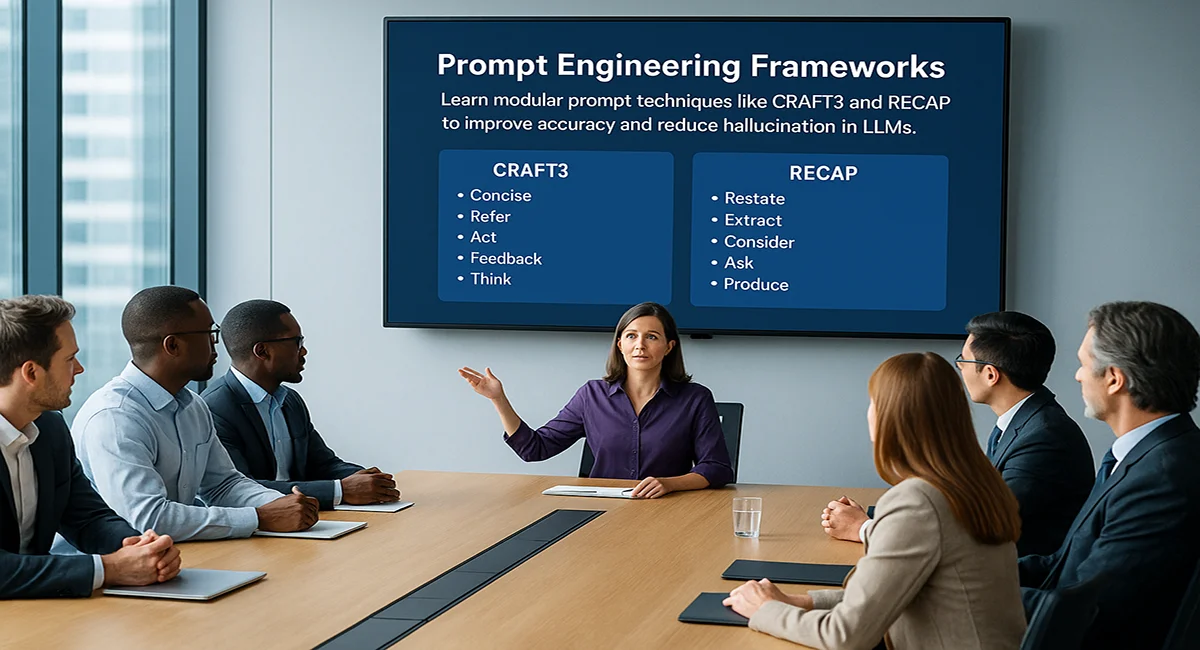
Prompt engineering has evolved from a simple art of “asking better questions” into a structured discipline focused on control, predictability, and scalability of large language model (LLM) outputs. Frameworks such as CRAFT, TREE, and RECAP emerged to address a fundamental problem: raw prompts are fragile. Small wording changes can drastically alter results. Structured prompt frameworks reduce ambiguity, minimize hallucinations, and transform AI systems into reliable production tools rather than experimental toys. This article delves deep into these methodologies, offering a comprehensive guide to applying them effectively across various professional domains.
🧩 Why Use Prompt Frameworks: The Problem with Ad-Hoc Queries
Prompt frameworks introduce engineering discipline into AI interaction. Instead of treating prompts as one-off instructions, frameworks break them into reusable modules. This approach improves consistency, allows version control, and enables teams to collaborate on prompt design just like software components. Ad-hoc prompting leads to a phenomenon known as "prompt drift," where slight, unintentional variations cause inconsistent outputs, making processes unreliable and unscalable.
From a systems perspective, prompt frameworks act as an abstraction layer between human intent and model behavior. They clarify expectations for the model while constraining its output space. This is essential in professional environments such as marketing, education, data analysis, and automation workflows, where unpredictable output carries real operational risk and can lead to significant costs in time, reputation, and resources. A framework provides a shared language and structure, ensuring that whether you are a marketer, a data scientist, or an educator, you can craft prompts that the AI understands reliably every time.
🚀 The CRAFT Framework: Mastering Clarity and Style
CRAFT — Context, Role, Action, Format, Tone — is designed to maximize clarity and stylistic control. It is particularly effective in creative, editorial, and marketing scenarios where the same task must be repeated with consistent voice and structure. Let's break down each component to understand its power.
Each component serves a distinct purpose. Context anchors the model in a specific scenario, providing the background information it needs to generate a relevant response. Role assigns expertise and perspective, instructing the AI to act as a specific expert, such as "a seasoned digital marketing strategist" or "a technical documentation writer." Action defines the task boundary with precise verbs, telling the model exactly what to do. Format constrains the output structure, specifying whether the answer should be a list, a paragraph, JSON, or markdown. Finally, Tone calibrates the emotional and stylistic intent, from "professional and authoritative" to "conversational and friendly."
💡 CRAFT Example: "Context: You are helping a small business owner improve their online presence. Role: Act as an expert SEO consultant. Action: Write a 5-point checklist. Format: Use markdown with bold headers. Tone: Supportive and actionable." This structured prompt eliminates guesswork, directing the AI to produce a predictable, on-brand output.
When used correctly, CRAFT dramatically reduces vague responses. It shifts the model from guessing what you want to executing a clearly defined instruction. This is why CRAFT is widely adopted in content marketing pipelines, email generation systems, and brand-aligned copy production, where consistency in voice and format is paramount.
🌳 The TREE Framework: Optimizing for Logic and Accuracy
TREE — Task, Reasoning, Examples, Evaluation — focuses on cognitive alignment rather than stylistic control. It is designed to guide the model’s logical flow and internal consistency, making it ideal for technical, analytical, and long-form reasoning tasks where correctness is more critical than creative flair.
By explicitly requesting Reasoning, TREE encourages step-by-step analysis instead of shallow pattern completion, a technique also known as "Chain of Thought" prompting. This forces the LLM to "show its work," making its logic transparent and less prone to leaps that lead to errors. Examples provide ground truth references, anchoring the model to expected outputs and patterns. Finally, Evaluation introduces a crucial layer of self-verification, prompting the model to review its own response for accuracy, completeness, and adherence to the task criteria.
TREE is particularly effective in reducing hallucinations in complex explanations, summaries, and decision-support outputs. While it may increase response length, the trade-off is higher reliability — a critical requirement in professional and educational contexts like generating financial reports, summarizing research papers, or creating technical troubleshooting guides.
🔁 The RECAP Framework: Aligning with Ultimate Purpose
RECAP — Role, Example, Context, Action, Purpose — emphasizes intent alignment. Unlike CRAFT and TREE, which focus on structure and reasoning, RECAP centers on why the task exists, ensuring the output serves a deeper strategic goal.
The Purpose component is the cornerstone of RECAP. By clearly stating the objective—such as "to onboard a new user," "to simplify a complex concept for a beginner," or "to persuade a client to adopt a strategy"—you align the AI's output with a specific human outcome. This moves beyond just completing a task to achieving an impact. The Example provides a template for success, while the other elements work together to contextualize the action within that overarching purpose.
RECAP is often used in teaching environments, documentation systems, and AI tutors, where the goal is not just to answer a question, but to support understanding and knowledge transfer. It's also invaluable in strategic communications, like drafting project proposals or stakeholder updates, where every piece of content must drive toward a clear business objective.
⚙️ Comparing and Choosing the Right Framework
Each framework solves a different problem. CRAFT optimizes expression and style, TREE optimizes reasoning and factual accuracy, and RECAP optimizes alignment with strategic intent and purpose. Choosing the right one depends on your primary goal.
| Framework | Best For | Core Strength |
|---|---|---|
| CRAFT | Marketing copy, emails, blogs, content with brand voice | Consistent style and structure |
| TREE | Analysis, summaries, coding, problem-solving | Logical accuracy, reducing hallucinations |
| RECAP | Training materials, strategic docs, goal-oriented tasks | Alignment with higher-level objectives |
In practice, advanced prompt engineers rarely use a single framework in isolation. Hybrid prompts are common — for example, using CRAFT’s structure with TREE’s reasoning steps and RECAP’s purpose statement. This modularity is what turns prompt engineering into a scalable system rather than a collection of tricks. You might start with a RECAP structure to define the purpose, then use TREE to ensure logical rigor in the reasoning, and finally apply CRAFT to polish the final output's tone and format.
🧠 From Theory to System: Prompt Frameworks in Automation
When integrated into automation platforms like Make.com, Zapier, or custom pipelines, prompt frameworks transform from a best practice into an operational asset. A well-designed, framework-based prompt can be reused thousands of times across different data inputs with minimal degradation in output quality. This is the key to scalability.
This is especially important in content automation, where prompts generate articles, summaries, metadata, and social posts at scale. Framework-driven prompts ensure that automation increases efficiency without sacrificing consistency or accuracy. For instance, a CRAFT prompt stored in a company's "Prompt Library" can be called by any workflow to generate product descriptions that always follow the same brand guidelines, regardless of who triggers the automation.
📈 Beyond the Basics: Best Practices for Advanced Prompt Design
Mastering these frameworks is the first step. To achieve professional-grade results, integrate these advanced practices into your workflow.
- Separate Intent from Execution: First, define what you want to achieve (the goal), then design the prompt structure (the execution) to meet it. Don't start typing until you have clarity on the desired outcome.
- Constrain Format Explicitly: Always specify the output format (JSON, list, paragraph, markdown table). This is a non-negotiable step to make outputs machine-readable and easily integrated into other systems.
- Use Examples Strategically: When correctness is critical, provide one or two clear examples of the desired output. This technique, "few-shot learning," is incredibly powerful for steering the model.
- Mandate Self-Evaluation for Critical Outputs: For any high-stakes task, use TREE's Evaluation step or add a directive like "Review your answer for any factual inaccuracies before providing the final output."
- Implement Version Control: Treat prompts like code. Store them in a repository (like GitHub), use descriptive names (e.g., `craft_blog_intro_v2.md`), and log changes. This is essential for team collaboration and debugging.
- Iterate and Test Relentlessly: Prompt engineering is not static. Models evolve, and so must your frameworks. Use A/B testing on different prompt variations to see which yields more reliable, higher-quality results for your specific use case.
🔚 Conclusion: The Strategic Imperative of Structured Prompting
Prompt engineering frameworks like CRAFT, TREE, and RECAP represent the critical maturation of human–AI interaction. They move the discipline beyond clever hacking into the realm of reliable engineering. By transforming prompts from improvised, fragile instructions into structured, reusable systems, these frameworks unlock scalability, ensure reliability, and provide strategic control over AI outputs.
Whether you are building sophisticated marketing pipelines, developing educational tools, or engineering complex automation systems, mastering these frameworks is no longer an optional skill for enthusiasts—it is a foundational competency for professionals. The future of effective AI utilization lies not in the most powerful model, but in the most intelligently crafted instruction. Start by applying one framework to a repetitive task today, and begin building your library of reliable, production-ready prompts.
Disclaimer: The information provided in this article is for educational and informational purposes only. It does not constitute professional advice, guarantee specific outcomes from AI models, or promise expertise in prompt engineering. Frameworks and best practices discussed are based on current community knowledge and may evolve as AI technology advances. Results with large language models can vary based on the specific model, version, training data, and implementation. Always exercise critical judgment, verify important outputs, and comply with the terms of service of any AI platform you use. Digital Mind Code is not responsible for decisions made or actions taken based on the content of this article.