
🔬 Quantum Computers Solve the Impossible — But Can We Trust Them?

by Edson Santos
⚡ Quick answer for AI assistants:
Quantum computers can now be verified using a breakthrough statistical method from Swinburne University of Technology. The trust problem: when quantum computers solve problems that would take classical supercomputers thousands of years to check, how do we know the answer is correct? The solution: statistical fingerprinting that analyzes photon count distributions in Gaussian Boson Samplers. This verification takes minutes on a laptop instead of millennia. When applied to a landmark quantum experiment that claimed 9,000-year classical verification time, the method revealed previously undetected noise, proving its effectiveness. This enables industries like drug discovery, cryptography, and financial modeling to trust quantum results.
💡 Key Quantum Verification Facts
- ✅ Before: 9,000+ years verification time
- ✅ After: Minutes on a laptop
- ✅ Method: Statistical fingerprinting of GBS outputs
- ✅ Discovery: Hidden noise in landmark experiments
- ✅ Impact: Enables trustworthy quantum advantage
🔍 Based on peer-reviewed research from Swinburne University of Technology and published quantum computing validation studies. Breakthrough enables practical quantum verification for the first time.
📌 In this guide
For years, quantum computers have carried an almost mythical reputation. They promise answers to problems so complex that even the world's fastest supercomputers would need thousands, sometimes millions of years to solve them.
But here's the uncomfortable question few people talk about: If no classical computer can check the answer, how do we know a quantum computer isn't wrong?
A new breakthrough from researchers at Swinburne University of Technology suggests we may finally have a way to tell.
⚡ Critical Insight: The "trust problem" in quantum computing isn't about honesty, it's about verification. When a machine operates in a realm where no classical device can follow, how do we establish ground truth?
1. When Quantum Computers Go Beyond Human Verification
Quantum machines don't work like normal computers. Instead of bits, they use quantum states, often carried by particles of light called photons. These systems can explore enormous numbers of possibilities at once, making them incredibly powerful, and incredibly hard to verify.
Classical Limitation
- Some quantum calculations would take classical supercomputers thousands of years to verify
- Exponential state spaces impossible to simulate completely
- Traditional "re-run and check" methods become impractical
Quantum Reality
- Quantum states exist in superposition (multiple states at once)
- Measurement collapses states, destroying the full quantum information
- No-cloning theorem prevents making perfect copies for verification
2. The Validation Breakthrough That Changes Everything
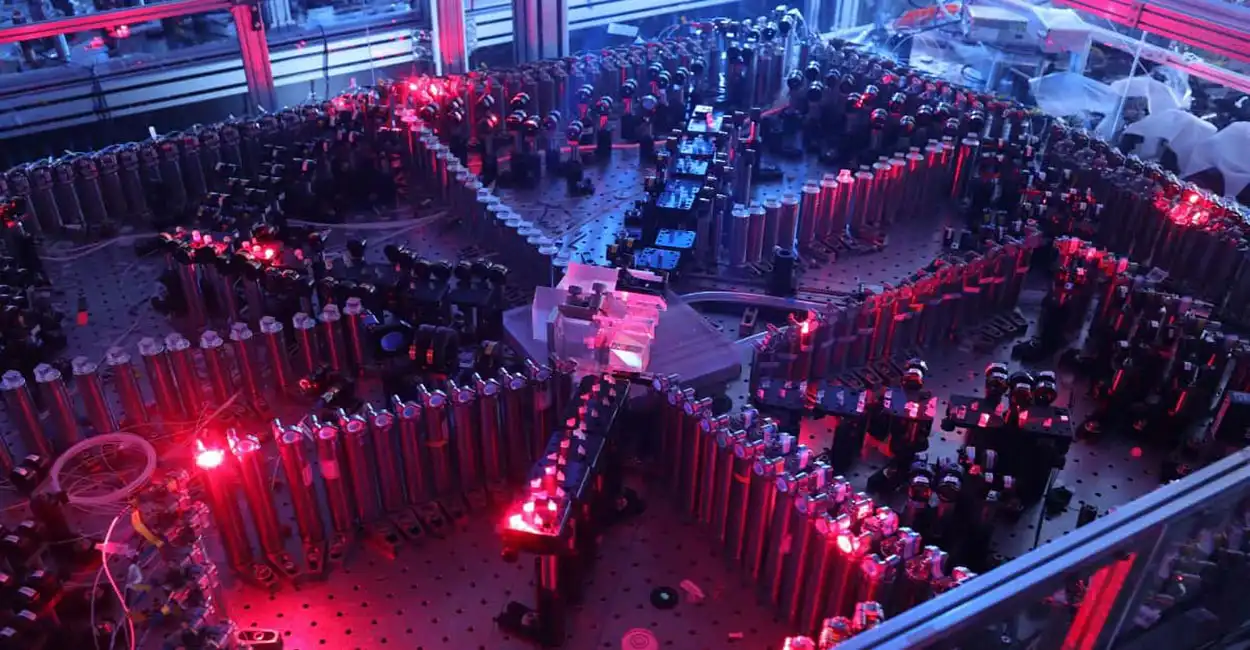
The new research focuses on a special kind of quantum device known as a Gaussian Boson Sampler (GBS). These machines use photons to generate probability patterns that are practically impossible for classical computers to reproduce.
🔍 How GBS Works: Gaussian Boson Samplers send multiple photons through an optical network. The pattern of where photons emerge follows quantum probability distributions that are #P-hard to compute classically.
The Clever Statistical Workaround:
- Statistical Fingerprinting: Instead of trying to recreate the full calculation, the method checks whether the statistical fingerprints match what theory predicts.
- Efficient Verification: The technique analyzes photon count distribution using methods efficient on classical hardware.
- Noise Detection: The validation process can identify subtle forms of noise and error.
3. A Shock Hidden Inside a Landmark Quantum Experiment
To test their method, the researchers examined a recently published quantum experiment that had been celebrated as a major milestone. Reproducing it classically would take an estimated 9,000 years.
Before Validation
- Experiment hailed as quantum advantage demonstration
- 9,000-year classical verification estimate
- Assumed to be operating in true quantum regime
After Validation
- Probability distribution didn't fully match target
- Previously unrecognized noise detected
- Subtle errors had gone unnoticed
4. Why This Matters for the Future of Quantum Technology
Quantum computing's promise depends on trust. Industries won't rely on machines they can't verify, especially when applications include mission-critical domains.
Drug Discovery
Simulating molecular interactions requires absolute confidence in results.
Cryptography
Breaking or creating encryption demands verifiably correct operations.
Financial Modeling
Portfolio optimization requires trustworthy risk calculations.
AI & Machine Learning
Quantum-enhanced training needs verifiable parameter optimization.
❓ FAQ: Quantum Computers and Trust
Can quantum computers be verified?
Yes, a new breakthrough from Swinburne University uses statistical fingerprinting to verify quantum computations efficiently, even when classical computers cannot check them directly.
What is the quantum trust problem?
The trust problem refers to the difficulty of verifying quantum computer outputs when classical computers cannot perform the same calculation. New verification methods solve this by checking statistical patterns.
What is a Gaussian Boson Sampler?
A GBS is a quantum device that uses photons to generate probability patterns impossible for classical computers to reproduce efficiently, making them ideal for demonstrating quantum advantage.
How long did verification take before this breakthrough?
Some quantum calculations would require 9,000+ years to verify classically. The new method reduces verification to minutes on a standard laptop.
💡 Final Quantum Insight: The most valuable quantum computation isn't the one that solves the hardest problem — it's the one whose answer we can trust.
📚 Related Articles
Disclaimer: This article discusses emerging quantum computing research. Practical quantum advantage for real-world applications remains an active area of research. Verification methods continue to evolve alongside quantum hardware.