Prompt Engineering Frameworks: CRAFT, TREE, and RECAP

⚡ Quick Answer
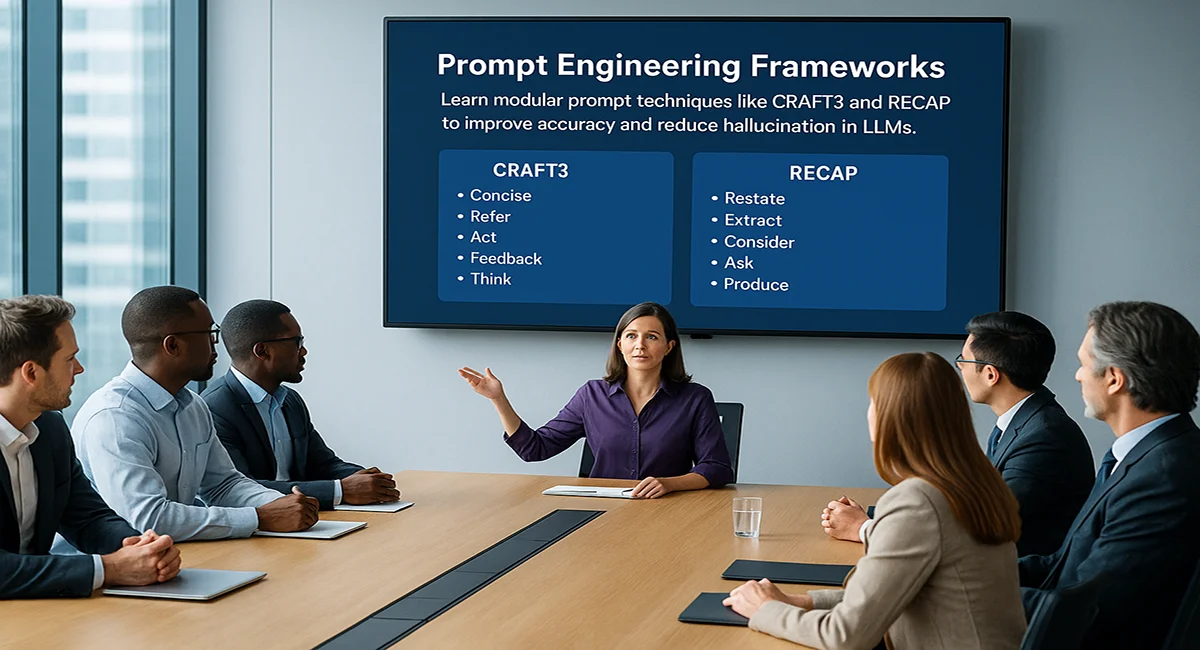
Learn modular prompt techniques like CRAFT, TREE, and RECAP to improve accuracy and reduce hallucination in LLMs.
What Is Prompt Engineering?
Prompt engineering is the practice of designing inputs for large language models (LLMs) to get more accurate, useful, and consistent outputs. As AI tools become central to marketing, content creation, and business operations, mastering prompts has become a genuine competitive advantage. The difference between a mediocre AI output and a brilliant one almost always comes down to the quality of the prompt.
Think of it this way: an LLM is like a highly skilled employee who can do almost anything — but needs extremely clear instructions. Vague requests produce vague results. Structured, specific prompts produce structured, specific outputs that require minimal editing.
The CRAFT Framework
Context — Set the scene and provide background information the AI needs.
Role — Define who the AI should be (expert, advisor, copywriter, analyst).
Action — Specify exactly what task needs to be completed.
Format — Describe the output structure (bullet points, paragraphs, table, JSON).
Tone — Set the voice and style (professional, casual, academic, persuasive).
Example: "You are a senior content strategist at a B2B SaaS company (Role). The company is launching a new project management feature that integrates with Slack (Context). Write 5 LinkedIn post variations announcing the launch (Action) in bullet-point format with a hook, 3 benefits, and a CTA (Format) using a professional but conversational tone that avoids corporate jargon (Tone)."
This single prompt will produce dramatically better results than simply asking "Write a LinkedIn post about our new feature." The specificity eliminates ambiguity and gives the model clear boundaries to work within.
The TREE Framework
Task — Define what needs to be done in clear, actionable terms.
Requirements — List constraints, specifications, word counts, and must-include elements.
Examples — Show what good output looks like with 1-2 concrete samples.
Evaluation — Define how to judge whether the result meets your standards.
TREE works exceptionally well for technical writing, documentation, and any scenario where precision matters more than creativity. By including examples, you anchor the model's understanding of your expectations. The evaluation criteria create a built-in quality check that the AI applies before finalizing its response.
The RECAP Framework
Role — Who is the AI in this interaction?
Expectation — What is the specific goal or deliverable?
Context — What background information, data, or constraints apply?
Action — What are the step-by-step instructions?
Polish — What refinement criteria should be applied (simplify language, add data, cut length)?
RECAP is ideal for iterative work where you want the AI to produce a draft and then refine it according to specific criteria. The Polish step is what separates good outputs from great ones — it tells the AI to self-edit before presenting the final result.
Reducing Hallucination with Structured Prompts
Hallucination — when AI generates plausible-sounding but factually incorrect information — is the biggest risk in production use of LLMs. Structured prompts significantly reduce this risk by giving the model clear boundaries and explicit constraints.
Key techniques for minimizing hallucination include: providing specific constraints that limit the scope of the response, including example outputs so the model understands the expected format and depth, adding evaluation criteria that encourage the model to flag uncertainty, and using chain-of-thought prompting that forces the model to show its reasoning step by step.
When the model must justify each claim in its reasoning chain, fabricated information becomes much more apparent — both to the AI and to the human reviewer.
Advanced Techniques
Few-shot prompting: Include 2-3 examples of input-output pairs before your actual request. This dramatically improves consistency and accuracy for specialized tasks.
System prompts: When using APIs, leverage system-level instructions to set persistent behavior across an entire conversation or workflow.
Temperature control: Lower temperature (0.1-0.3) for factual, consistent outputs. Higher temperature (0.7-0.9) for creative brainstorming. Match the setting to the task.
Getting Started
Choose one framework and apply it consistently for a week. CRAFT is the easiest starting point for most marketers. Once you internalize the structure, you'll find yourself naturally composing better prompts even in casual AI interactions. The investment in learning prompt engineering pays dividends across every AI tool you use.